SPECIAL
SALE Until Midnight, Sunday, July 14, 2016 - Receive $15.00 Off
Any Order Over $130.00. Use
The Coupon Code ATM13015.
The Ask The Meatman™
Website is Owned
and Operated By:
Jackson Frozen Food Locker
400 South High St.,
Jackson, MO 63755
Craig Meyer/Owner
is the MEATMAN!
We Accept
Orders By Phone With Credit/Debit Cards Our Phone Orders Are Accepted 9:00 a.m. to 4:00
p.m (CST) Monday through
Friday.
To place a telephone order call
573-837-7651
We Ship Most
Of Our
Orders by USPS
(United States
Postal Service).
Click on a section of the Hind Quarter to view the cut of meat processed from that Section of Beef. At the bottom of this page, you will find a text description of each cut of the hind quarter and cooking tips for each cut!
This DVD is 2 HOURS LONG and includes Chapter Menus for EASY Navigation! These are in DVD+R Format and will play on ANY DVD Player! We show how to process a beef using a meat band saw, grinder, knives and meat handsaw.
We have received a very thoughtful and
helpful review of our Beef Processing and Beef Slaughtering
DVD's from Jill Winger at
The Prairie Homestead.
For anyone wanting to learn how to "live off the land" - we
highly recommend this website.
This is an unbiased review (along with photo's) that we think
those interested in purchasing any of our DVD's will be very
interested in! You can read the review by clicking here.
Below is a short clip from Our Beef Processing DVD
Order Your Ask The Meatman Beef Processing DVD™ for ONLY $24.97 TODAY by clicking on the "Add To Cart" button below! Shipped FREE!
Click this picture to see a larger view of the 8 Primal Cuts on a Beef.
If you are planning on cutting your own beef hind quarter, you will need a good boning knife. Why not order one of our Forschner-Victorinox 5 Inch Boning Knives! This is the same knife we have used for decades at Jackson Frozen Food Locker. Order one today for only$24.99 - shipping included in this price! We believe we have the lowest price on the Internet on Forschner Boning Knives. If you find a lower price, including shipping, please e-mail us, and we will try and beat that price!
Prime Grade- is produced from young, well-fed beef cattle. Only 2% of the beef in the U.S. is graded Prime. It has abundant marbling and is generally sold in restaurants and hotels. Prime roasts and steaks are excellent for dry-heat cooking (i.e., roasting, broiling, and grilling).
· Choice Grade- is high quality, but has less marbling than Prime. Choice roasts and steaks from the loin and rib will be very tender, juicy, and flavorful and are, like Prime, suited to dry-heat cooking. Many of the less tender cuts, such as those from the rump, round, and blade chuck, can also be cooked with dry heat, but be careful not to overcook them. Using a meat
thermometer takes the guesswork out of cooking and assures a safe internal temperature: 145 ° F is medium rare; 160 ° F, medium; and 170 ° F, well done.
Choice Grade is also subdivided further by Yield Grades. Yield Grade 1 is the best. Yield Grade 5 is the "Least" best.
· Select Grade- is very uniform in quality and normally leaner than the higher grades. It was formerly named Good Grade. It is fairly tender, but, because it has less marbling, it may lack some of the juiciness and flavor of the higher grades. Only the tender cuts (loin, rib, sirloin) should be cooked with dry heat. Other cuts should be marinated before cooking or cooked with moisture to obtain maximum tenderness and flavor.
· Standard and Commercial grades – frequently are sold as ungraded or as "store brand" meat.
· Utility, Cutter, and Canner grades - are seldom, if ever, sold at retail but are used instead to make ground beef and processed products.
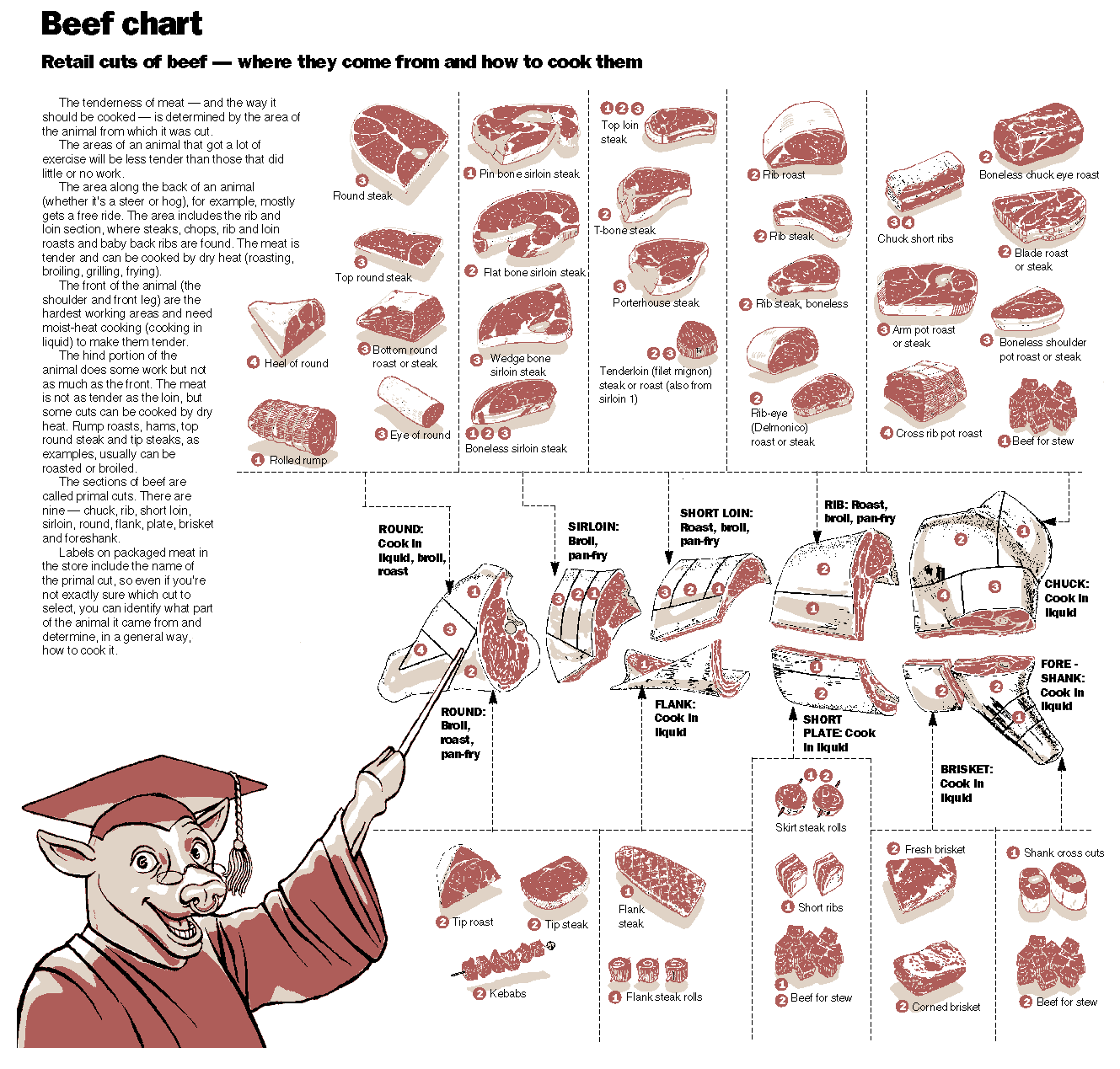
Short Loin Cuts from this area are very tender, and can be prepared without the aid of moist heat or long cooking times. You can sauté, pan fry, broil, pan broil, or grill these cuts. The steaks cut from this area are especially tender.
Porterhouse Steak - Cut from the rear end of the short loin, porterhouse is very popular. The name originated from the days when it was served in public alehouses that also served a dark beer called porter. It consists of a hefty chunk of tenderloin with an even heftier chunk of sirloin tip. Some folks like to remove the tenderloin to serve separately as filet mignon. Others cook the whole thing, and cut it into several portions.
T-bone Steak - Cut from the middle section of the short loin, a T-bone steak is similar to the porterhouse steak; it has a smaller piece of the tenderloin. Grilled or pan-fried, this steak is tender and tasty.
Club Steak - This steak has many names - Delmonico, New York strip loin, Kansas City steak, strip steak, and shell steak. It is cut from the rib end of the short loin. It has a bone along one side, and contains no portion of tenderloin.
Tenderloin - Although considered by many to be the most tender cut of beef, this portion of the loin seems to have less of that meaty flavor. For this reason it responds well to sauces, meaning the meat does not overpower the flavor of the sauce. It can be cut as the whole strip, or into individual steaks for filet mignon.
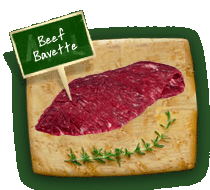
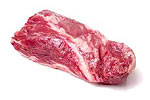
{Bavette Steak} Weighs approximately 3 lbs.. Cut from the short loin, this steak is sliced thin and can be pan-broiled.
The sirloin is where the backbone's connected to the hipbone. Still very tender, these cuts respond well to sautéing, pan-frying, broiling, pan-broiling, or grilling. Marinating is recommended.
Sirloin Steaks - Come with three varieties of bones. The pin bone steak is the most tender, followed in order of decreasing tenderness by the flat, round, and wedge bone steaks. These are large steaks, suitable for the whole family. Sirloin steaks are also available in a variety of boneless steaks.
Sirloin Tip Roast - Tender enough for a dry roasting method, this roast is best when well marinated.
Round has become popular as of late due to the leanness of the meat. However, there is a lot a of variability in the tenderness of cuts from this section. Err on the side of long, moist cooking methods.
Top Round - This is the most tender part of the round; it can be prepared as pot roast, or cut into thick steaks for braised dishes.
Rump Roast - This is a very popular cut for pot roast, but can also be roasted at low temperatures.
This meat is lean and muscular. As expected it is somewhat tough, but is also flavorful. Flank is primarily used for flank steaks and rolled flank steaks. It can also be used for kabobs. Medium-rare is the perfect doneness for these cuts; anything more, and the meat will be dry and tough.
Flank Steak - This steak has a great flavor, and should be sliced against the grain for maximum chewability.
Hanger Steak
Other Common Names For This Cut: Hanging Tender. This steak is part of the diaphragm muscle and is best served rare or medium rare.
Last Updated -
Wednesday, February 10, 2016 02:30 PM
If you found this page interesting, you may also want to look at the following pages:
Don't forget to order your Notebook Size Meat Cutting Charts (pictured below) to use as a handy reference guide to ALL the beef cuts available!
These charts are extremely useful if you cut your own beef or just want to know what options you have at the Butcher Shop or Grocery Store Meat Department!
PurchaseA Set of 5 Notebook Size Meat Charts For ONLY $7.00 by Clicking the "Add To Cart" Button Below. Shipped FREE in the U.S.!
We are NOT JUST a Retail Home Butcher Supply Store! We ACTUALLY Process Beefs, Hogs and Deer.
We Have Since 1949! And we continue to do so today.
WE ONLY SELL PRODUCTS THAT WE USE!
You may want to check out other Home Butcher Supply Web stores and see if they actually use the products that they sell in "Their" Meat Processing Plant (that is, if they have one!).